Commercial kitchens are one of the highest fire-risk environments a business can operate. Between deep fryers, open flames, and grease buildup in the exhaust system, a small flare-up can turn into a serious fire in seconds. That’s exactly why hood suppression systems, proper extinguishers, and emergency lighting all work together as a single life-safety system — not separate boxes to check.
A+ Fire Protection Services got its start in the commercial kitchen industry, and kitchen fire protection is still at the core of what we do for restaurants, cafeterias, and food service businesses across Chicagoland and Central/Western Indiana.
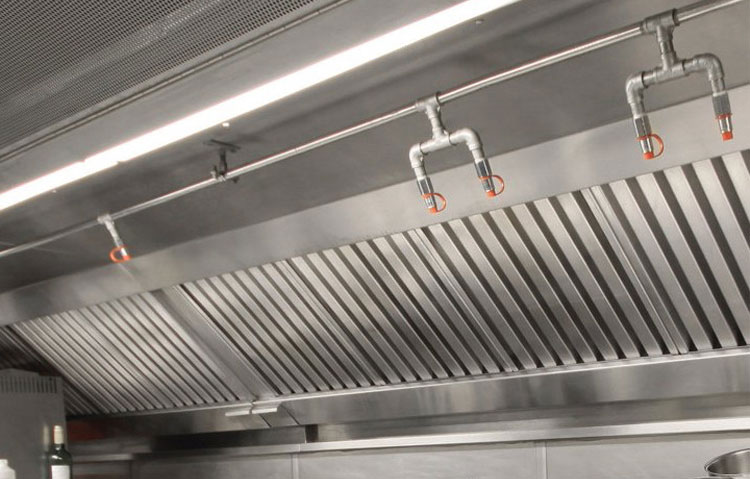
A kitchen hood suppression system is designed to detect heat from a fire near the cooktop and automatically discharge a wet chemical agent onto the cooking surface, hood, and duct — while also shutting off the fuel or gas supply to the appliances. This happens whether or not anyone is standing nearby, which is critical during high-volume shifts when staff may not notice a flare-up immediately.
We specialize in two of the most widely used systems in the industry:
Whether you’re installing a new system, upgrading an aging one, or need ongoing service and repairs, our technicians handle installation, sales, service, and estimates for both platforms.
Your hood system handles the cooking surface, but you also need a properly rated portable extinguisher on hand for grease fires that spread beyond it. K Class extinguishers are specifically formulated for the high-temperature grease and oil fires common in commercial kitchens — a standard ABC dry chemical extinguisher isn’t rated for that job and can actually make a grease fire worse.
If you’re not sure which extinguisher types your kitchen needs, our post on fire extinguisher maintenance schedules breaks down the difference between Dry Chemical, CO2, Halotron, Water, and K Class units, along with how often each needs to be inspected, recharged, and tested.
Fire suppression gets most of the attention, but NFPA life safety code also requires working emergency exit lighting so staff and customers can safely evacuate if power is lost during a fire. This is an area where we see a lot of businesses fall out of compliance without realizing it, since the testing requirements are easy to forget between inspections:
We handle new fixture installation, battery replacement, bulb replacement, and both testing intervals, so you’re not tracking multiple compliance deadlines on your own — and so you avoid fines during a fire marshal inspection.
The properties that stay compliant year after year treat suppression, extinguishers, and emergency lighting as one coordinated system rather than three separate vendors. That’s the approach we take with every commercial kitchen client: one team managing your hood system, extinguishers, alarms, and lighting, with documentation ready whenever your local AHJ or insurance carrier asks for it.
How often does a kitchen hood suppression system need to be serviced? Hood suppression systems generally require inspection every six months, in line with NFPA 96 requirements. Kitchens with heavy daily use may need more frequent checks — we can recommend a schedule based on your volume.
Do I need both a hood system and a K Class extinguisher? Yes. The hood system protects the cooking surface and duct automatically, but a K Class portable extinguisher is your backup for grease fires that escape that zone or occur elsewhere in the kitchen.
What’s the difference between Buckeye and Pyro-Chem systems? Both are reliable wet chemical suppression platforms; the right choice usually comes down to your kitchen’s layout, existing equipment, and manufacturer compatibility. Our technicians can evaluate your space and recommend the best fit — see our full services page for everything included.
Do you offer multi-unit discounts for restaurant groups? Yes, we provide clear, transparent estimates and multi-unit discounts for commercial properties managing more than one location.
Is emergency lighting really required if we already have suppression and extinguishers in place? Yes — emergency lighting is a separate NFPA life safety code requirement focused on safe evacuation, not fire suppression. Missing or untested emergency lighting is one of the most common violations we see during inspections.
Whether you need a new hood system installed, an existing one serviced, or a full compliance check across your kitchen, contact A+ Fire Protection Services for a free estimate, or read more about our two decades of experience protecting commercial kitchens across the region.